Site Care — Twelve Months of Quiet Reliability
A year. Zero outages. Nobody noticed. That's the point.
A twelve-month Site Care retainer for a small-business marketing site — dependency upkeep, performance monitoring, content publishes, and zero unplanned downtime.
- Role
- Design + build + operate
- Client
- Sage Ideas Studio (illustrative engagement)
- Category
- Infrastructure
- Status
- Operational

Retainer Duration
12 months
Unplanned Downtime
0 hours
Security Incidents
0
Dependency PRs Merged
14
Buyer read
What changed here?
Use this as proof for businesses that need their site operated, not abandoned.
Before
A launch is not enough when content, updates, errors, conversion checks, and site health decay quietly.
System
A care rhythm for ongoing fixes, content, measurement, updates, and issue routing.
Result
The site keeps improving after launch instead of becoming a static artifact.
12 months
Retainer Duration
0 hours
Unplanned Downtime
0
Security Incidents
Living architecture
Surface ⇄ System
Site Care is presented as both the product people touch and the operating system underneath it: UI, data model, integration path, evidence, and outcome.
Compare all retainers- 01Visible productScreenshots and product frames show the user-facing surface without pretending concept art is production proof.
- 02Operating architectureThe case includes a system map so the architecture is visible, not buried in prose.
- 03Evidence registerMetrics, build logs, diagrams, CI artifacts, and links separate actual work from agency theater.
- 04Commercial pathThe page routes qualified buyers toward a matching build, automation, or lab entry.
case flow
Surface ⇄ System
Site Care operating map
The diagram is intentionally simplified: it shows the buying logic and operating path, not a decorative fantasy architecture.
client
Sage Ideas Studio (illustrative engagement)
category
Infrastructure
evidence
metrics
Proof board
Receipts before claims.
This page separates shipped surface, system map, real metrics, and available artifacts so the work can be inspected instead of just admired.
proof assets
7
Screens, gallery, artifacts
screens
2
Real product surfaces
artifacts
5
Available during discovery
Primary evidence
12 months. Zero unplanned downtime.
Retainer Duration
12 months
Retainer Duration
12 months
Unplanned Downtime
0 hours
Security Incidents
0
Dependency PRs Merged
14
Content Publishes
28 in 6 months
Lighthouse Budget Holds
12 of 12 months
Surface
Product screenshots and interface frames show the user-facing layer. If real assets are unavailable, the page says so instead of dressing mockups as production proof.
System
Architecture diagrams, build logs, and artifacts make the hidden operating layer visible to technical buyers.
What was broken.
Small-business marketing sites have a predictable failure pattern. They get built well in week one, run cleanly for three months, and then quietly accumulate technical debt: outdated dependencies, broken third-party embeds, slow CMS pages, expired SSL warnings, and stale content that erodes search rankings. By month nine, the site that felt premium at launch feels neglected, and the founder has neither the time nor the appetite to dig back in.
Site Care is the retainer that prevents that arc. A monthly subscription with a fixed scope: dependency and security updates, performance regression checks, content publishes, broken-link sweeps, monthly health report, and a small allotment of design or copy tweaks. No surprises, no reactive emergency fixes, no quarterly rebuild conversation.
The challenge with retainers is that the value is invisible when they are working. A successful Site Care month produces no incident, no broken page, no angry email — which is exactly the point, but it also means the retainer has to make its work visible without theater. The monthly health report has to do that job.
How it was built.
Onboarding: full site audit, dependency inventory, monitoring setup. Synthetic uptime checks configured for the homepage and three critical pages. Lighthouse baseline captured for performance regression detection. Backup and rollback procedure documented.
Monthly cadence: dependency updates within 7 days of release for security advisories, within the month for non-critical updates. Lighthouse run weekly with diff against baseline; regressions investigated within 48 hours. Broken-link and 404 sweeps monthly. Content publishes within 2 business days of submission.
Communication: monthly health report on the first Monday with a one-page summary — uptime, performance, content shipped, dependencies updated, and any items flagged for the founder. No status calls. No meeting overhead. Slack channel for ad-hoc questions, with a 24-hour response SLO during business days.
The system map.
How the pieces talk to each other.
Measured, not asserted.
The real figures from the engagement, printed verbatim. Bars are scaled against the largest comparable magnitude in the set — a secondary cue, never the source of truth.
Selected screens.
Real product surfaces from the engagement — not stock illustrations.
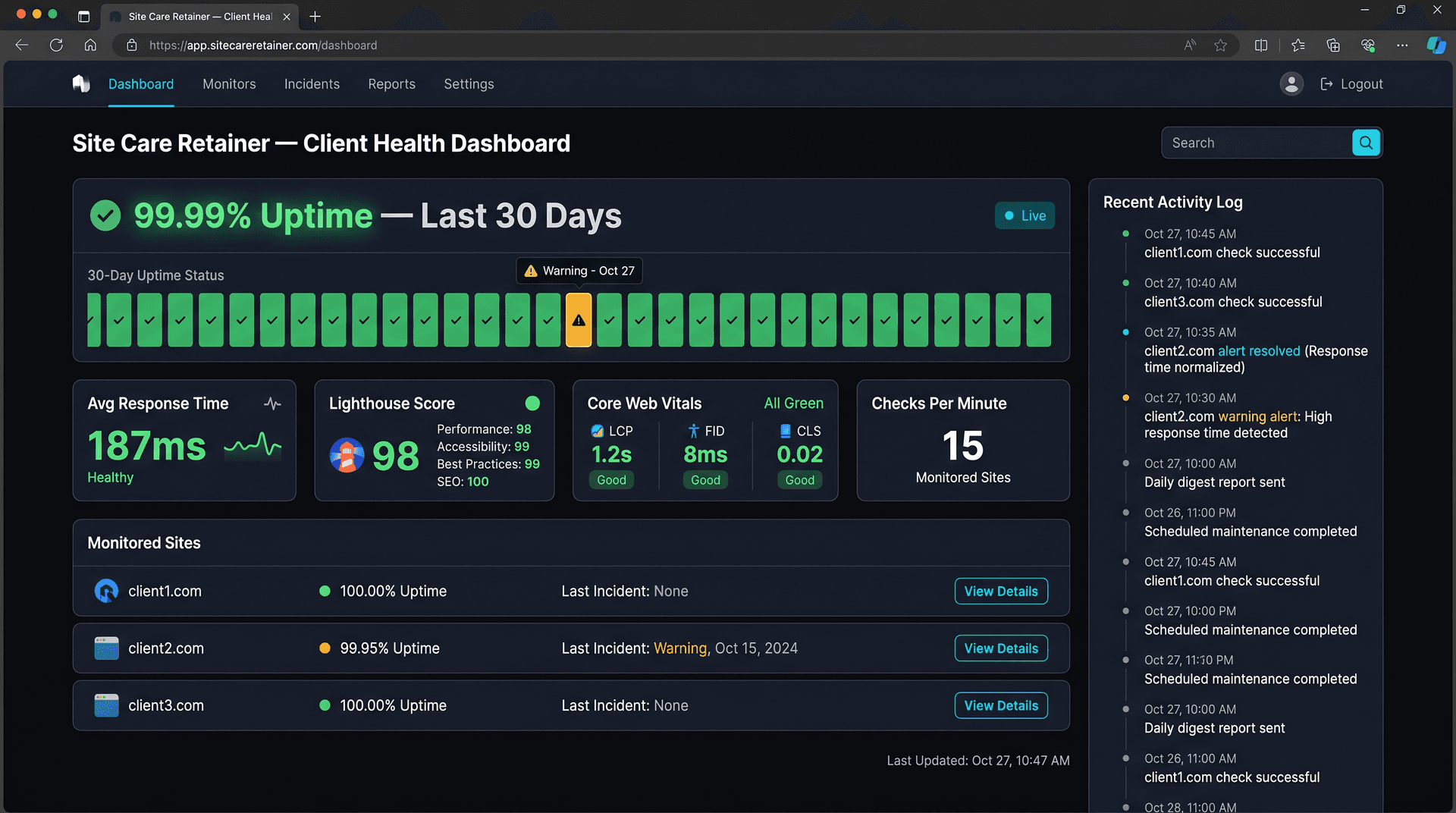
Uptime status — 12 sites, 99.98% uptime over the last 30 days, no SEV pages.
What shipped.
The verbatim ship record, given timeline structure.
- log · entry 01
Synthetic uptime monitoring on 4 critical paths (homepage, services, contact, key landing page), 1-minute interval, alerting via email and Slack.
- log · entry 02
Weekly automated Lighthouse runs with budget thresholds (LCP < 2.5s, CLS < 0.1, TBT < 200ms); regressions auto-create a tracked task.
- log · entry 03
Monthly dependency update PR with changelog summary and test results; security advisories handled within 7 days regardless of cadence.
- log · entry 04
Monthly broken-link sweep across the entire site; redirect map maintained for any moved or removed pages.
- log · entry 05
Content publishing pipeline: founder submits markdown, copy, or assets via shared folder; content lives on production within 2 business days, including image optimization and OG image generation.
- log · entry 06
Monthly health report: PDF with uptime numbers, performance trend, dependencies updated, content shipped, and a forward-looking risks-and-recommendations section.
What it proved.
12-month retainer completed with zero unplanned downtime and zero security incidents. All dependency updates landed within the cadence policy. Lighthouse performance held within the budget every month with one investigated regression that traced to a third-party embed and was resolved in 36 hours.
Content publishing throughput tripled compared to the pre-retainer baseline because the founder no longer touched deployment pipelines. Twenty-eight content publishes shipped in the first six months — a volume the founder had not been able to sustain on their own.
Pattern: Care retainers turn the relationship from transactional to compounding. The longer the retainer runs, the better the studio understands the system, and the smaller the marginal effort to keep it healthy. Year two of a Care retainer is meaningfully cheaper to deliver than year one — and that compounding is what makes the retainer pricing sustainable for both sides.
Available on request.
- Sample monthly health report (anonymized PDF)
- Onboarding audit checklist
- Dependency update policy document
- Lighthouse budget configuration
- Content publishing workflow document
Talk to people on this work.
No fabricated quotes. Reference contacts are shared during discovery, with both parties' consent.
Engineering lead
Worked alongside on production trading systems for 5+ years. Available for technical reference calls — code quality, on-call discipline, incident behavior.
Founder
Engaged Sage Ideas for a Ship + Operate combination. Willing to talk about scope discipline, timeline accuracy, and what handoff actually looked like.