Jobpoise — AI Job Copilot
The job search, weaponized for the qualified.
A citation-grounded AI job application copilot with Chrome extension, Gmail tracking, and three pricing tiers.
- Role
- Design + build + operate
- Client
- Sage Ideas (Internal)
- Category
- Product
- Status
- Operational

CI Gates
5/5
Pricing Tiers
3
Job Boards
LinkedIn, Indeed, Greenhouse
Open PRs (main)
0
Buyer read
What changed here?
Use this as proof for AI products that need guardrails, workflow fit, and a payment-ready surface.
Before
Job-search AI often invents, overgeneralizes, or generates content disconnected from the user’s actual proof.
System
A citation-grounded job copilot with Chrome extension workflow, Gmail tracking, Stripe tiers, and structured application support.
Result
The product proves AI can support a serious workflow without fabricating experience or losing the human trail.
5/5
CI Gates
3
Pricing Tiers
LinkedIn, Indeed, Greenhouse
Job Boards
Living architecture
Surface ⇄ System
Jobpoise is presented as both the product people touch and the operating system underneath it: UI, data model, integration path, evidence, and outcome.
Build a product like this- 01Visible productScreenshots and product frames show the user-facing surface without pretending concept art is production proof.
- 02Operating architectureThe case includes a system map so the architecture is visible, not buried in prose.
- 03Evidence registerMetrics, build logs, diagrams, CI artifacts, and links separate actual work from agency theater.
- 04Commercial pathThe page routes qualified buyers toward a matching build, automation, or lab entry.
case flow
Surface ⇄ System
Jobpoise operating map
The diagram is intentionally simplified: it shows the buying logic and operating path, not a decorative fantasy architecture.
client
Sage Ideas (Internal)
category
Product
evidence
metrics
Proof board
Receipts before claims.
This page separates shipped surface, system map, real metrics, and available artifacts so the work can be inspected instead of just admired.
proof assets
2
Screens, gallery, artifacts
screens
2
Real product surfaces
artifacts
0
Available during discovery
Primary evidence
The job search, engineered.
CI Gates
5/5
CI Gates
5/5
Pricing Tiers
3
Job Boards
LinkedIn, Indeed, Greenhouse
Open PRs (main)
0
Surface
Product screenshots and interface frames show the user-facing layer. If real assets are unavailable, the page says so instead of dressing mockups as production proof.
System
Architecture diagrams, build logs, and artifacts make the hidden operating layer visible to technical buyers.
Job-search copilot loop
Surface, system, proof, route.
This storyboard turns the case study into a moving operating map: the buyer sees what was built, where the system lives, and which proof points are actually available.
- sessions
- 8-question
- billing
- 3 tiers
- workflow
- Gmail
What was broken.
Job seekers face a documentation problem, not an inspiration problem. They know what they want to say — they just need help saying it in language that matches the role, passes ATS screening, and sounds like a human wrote it. Tools that generate generic cover letters from nothing miss the entire point.
Jobpoise was built around citation-grounded generation: every piece of AI-generated content traces back to the candidate's actual experience, the actual job description, and named sources. No hallucinated accomplishments. No fabricated skills.
The challenge: building a product that is technically defensible (citation-grounded), commercially sustainable (Stripe paywall with sensible tier design), and usable in the actual workflow (Chrome extension for in-browser job applications and Gmail integration for application tracking) — all in a single Next.js monorepo.
How it was built.
Monorepo: Next.js 15 with Turborepo — web app and Chrome extension as separate packages, sharing types and utility functions. AI layer: GPT-4 with structured prompting for citation-grounded generation. Every output includes a citation map linking content to input sources (resume bullets, JD requirements).
Chrome extension: Manifest V2, injects into major job board UIs (LinkedIn, Indeed, Greenhouse), enables one-click draft generation from the current JD. Gmail integration: OAuth-scoped Gmail API access to track sent applications, surface follow-up timing, and detect response patterns.
Billing: Stripe Checkout + Customer Portal. Three tiers — Drift (free) to prove value, Poise ($39/mo) for unlimited generations + Gmail tracking, Compose ($79/mo) for Chrome extension + priority processing. CI: 5 CI checks passing on main — type check, lint, unit tests, build, and E2E smoke test.
The system map.
How the pieces talk to each other.
Measured, not asserted.
The real figures from the engagement, printed verbatim. Bars are scaled against the largest comparable magnitude in the set — a secondary cue, never the source of truth.
Selected screens.
Real product surfaces from the engagement — not stock illustrations.
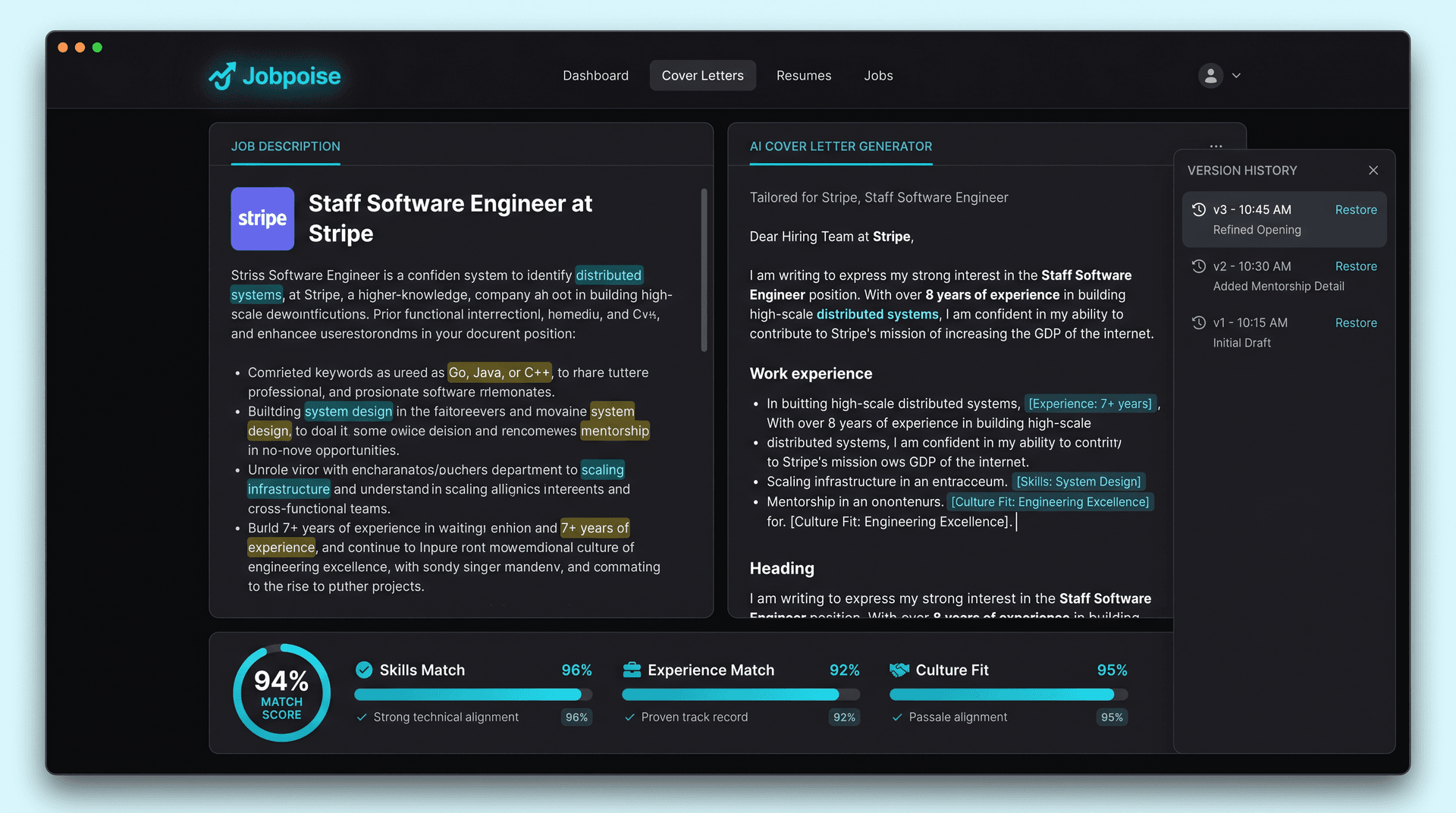
Mock interview — behavioral set, real-time transcription, structured rubric scoring.
What shipped.
The verbatim ship record, given timeline structure.
- log · entry 01
Next.js 15 monorepo (web app + Chrome extension as packages). Citation-grounded AI generation (GPT-4 + structured prompt layer). Chrome extension v2 with job board injection. Gmail OAuth integration with application tracking dashboard.
- log · entry 02
Stripe Checkout + Customer Portal (3 tiers). 5 CI checks passing on main branch. Production deployment with auth, data persistence, and billing all live.
What it proved.
Fully merged main branch — no open feature PRs blocking production. All 5 CI gates passing: TypeScript, ESLint, unit tests, build, E2E smoke. Stripe billing live and processing test transactions.
Chrome extension functional on LinkedIn, Indeed, and Greenhouse. Three-tier pricing model ready for go-to-market.
A monorepo with a web app and a browser extension, sharing types and utilities, can be built and maintained by a single engineer without sacrificing CI discipline. The citation-grounding architecture is the differentiator — it's what separates Jobpoise from a GPT wrapper with a job-shaped UI.
Talk to people on this work.
No fabricated quotes. Reference contacts are shared during discovery, with both parties' consent.
Engineering lead
Worked alongside on production trading systems for 5+ years. Available for technical reference calls — code quality, on-call discipline, incident behavior.
Founder
Engaged Sage Ideas for a Ship + Operate combination. Willing to talk about scope discipline, timeline accuracy, and what handoff actually looked like.