Brand Sprint — Founder-Led Identity Rebuild
Two weeks to look like a company that ships.
A two-week Brand Sprint for an early-stage founder transitioning from a personal portfolio to a productized studio identity.
- Role
- Design + build + operate
- Client
- Sage Ideas Studio (illustrative engagement)
- Category
- Product
- Status
- Operational

Sprint Duration
10 business days
Identity Tokens
12 colors + 6 type
Voice Doc
4 pages
Logo Variants
3 directions, 1 final
Buyer read
What changed here?
Use this as proof for service businesses that need the website to sell the offer faster.
Before
A business can have a polished site that still fails because the offer, proof, and buyer path are unclear.
System
A brand and conversion sprint that reconnects positioning, proof assets, page structure, and action paths.
Result
The buyer stops guessing what the business does and starts seeing the version they want to hire.
10 business days
Sprint Duration
12 colors + 6 type
Identity Tokens
4 pages
Voice Doc
Living architecture
Surface ⇄ System
Brand Sprint is presented as both the product people touch and the operating system underneath it: UI, data model, integration path, evidence, and outcome.
Pair with Brand Care- 01Visible productScreenshots and product frames show the user-facing surface without pretending concept art is production proof.
- 02Operating architectureThe case includes a system map so the architecture is visible, not buried in prose.
- 03Evidence registerMetrics, build logs, diagrams, CI artifacts, and links separate actual work from agency theater.
- 04Commercial pathThe page routes qualified buyers toward a matching build, automation, or lab entry.
case flow
Surface ⇄ System
Brand Sprint operating map
The diagram is intentionally simplified: it shows the buying logic and operating path, not a decorative fantasy architecture.
client
Sage Ideas Studio (illustrative engagement)
category
Product
evidence
metrics
Proof board
Receipts before claims.
This page separates shipped surface, system map, real metrics, and available artifacts so the work can be inspected instead of just admired.
proof assets
7
Screens, gallery, artifacts
screens
2
Real product surfaces
artifacts
5
Available during discovery
Primary evidence
Two weeks. One identity system. Shipped.
Sprint Duration
10 business days
Sprint Duration
10 business days
Identity Tokens
12 colors + 6 type
Voice Doc
4 pages
Logo Variants
3 directions, 1 final
Site Pages Treated
8
Follow-on Rebuild
0
Surface
Product screenshots and interface frames show the user-facing layer. If real assets are unavailable, the page says so instead of dressing mockups as production proof.
System
Architecture diagrams, build logs, and artifacts make the hidden operating layer visible to technical buyers.
What was broken.
Personal portfolios and small-business sites tend to accumulate years of inconsistent visual decisions — four typefaces, three accent colors, mismatched logo treatments, and copy written by different people at different stages of the business. The site works, but it does not feel coherent, and it does not signal seriousness to the small businesses the studio is trying to serve.
The Brand Sprint engagement is designed for exactly this moment. Two weeks, one founder, one identity system shipped end-to-end. No quarterly brand-strategy retainer. No multi-stakeholder workshops. The founder sets the direction, the studio executes the system.
The challenge is compression. A traditional brand rebuild burns three months on discovery and stakeholder rounds before a single asset ships. A Brand Sprint has to land a complete identity — logo, type, color, voice, and a working site treatment — in ten business days without cutting corners on the things that actually matter.
How it was built.
Day 1–2: Discovery. Audit of the existing assets, copy patterns, and competitive landscape. Founder interview to extract the underlying voice and the one-sentence positioning statement. Output: a written brand brief signed off before any visual work begins.
Day 3–5: System design. Custom SVG wordmark and monogram drafted in three directions. Type pairing chosen from a curated shortlist (typically Satoshi or General Sans for body, with a stronger display face for hero moments). Color system: a neutral surface palette plus one signal accent and one secondary, all token-mapped.
Day 6–8: Voice and copy system. Voice document covering tone, vocabulary, sentence rhythm, and the things the brand never says. Boilerplate copy blocks for hero, services, footer, and email signature. Reusable header and CTA patterns.
Day 9–10: Application. Identity applied to the existing site — navigation, hero, service cards, footer, OG image template, and favicon. All tokens written into the design system file. Final handoff package: SVG logo set, color hex/Tailwind tokens, type stack, voice doc, and a one-page brand guide PDF.
The system map.
How the pieces talk to each other.
Measured, not asserted.
The real figures from the engagement, printed verbatim. Bars are scaled against the largest comparable magnitude in the set — a secondary cue, never the source of truth.
Selected screens.
Real product surfaces from the engagement — not stock illustrations.
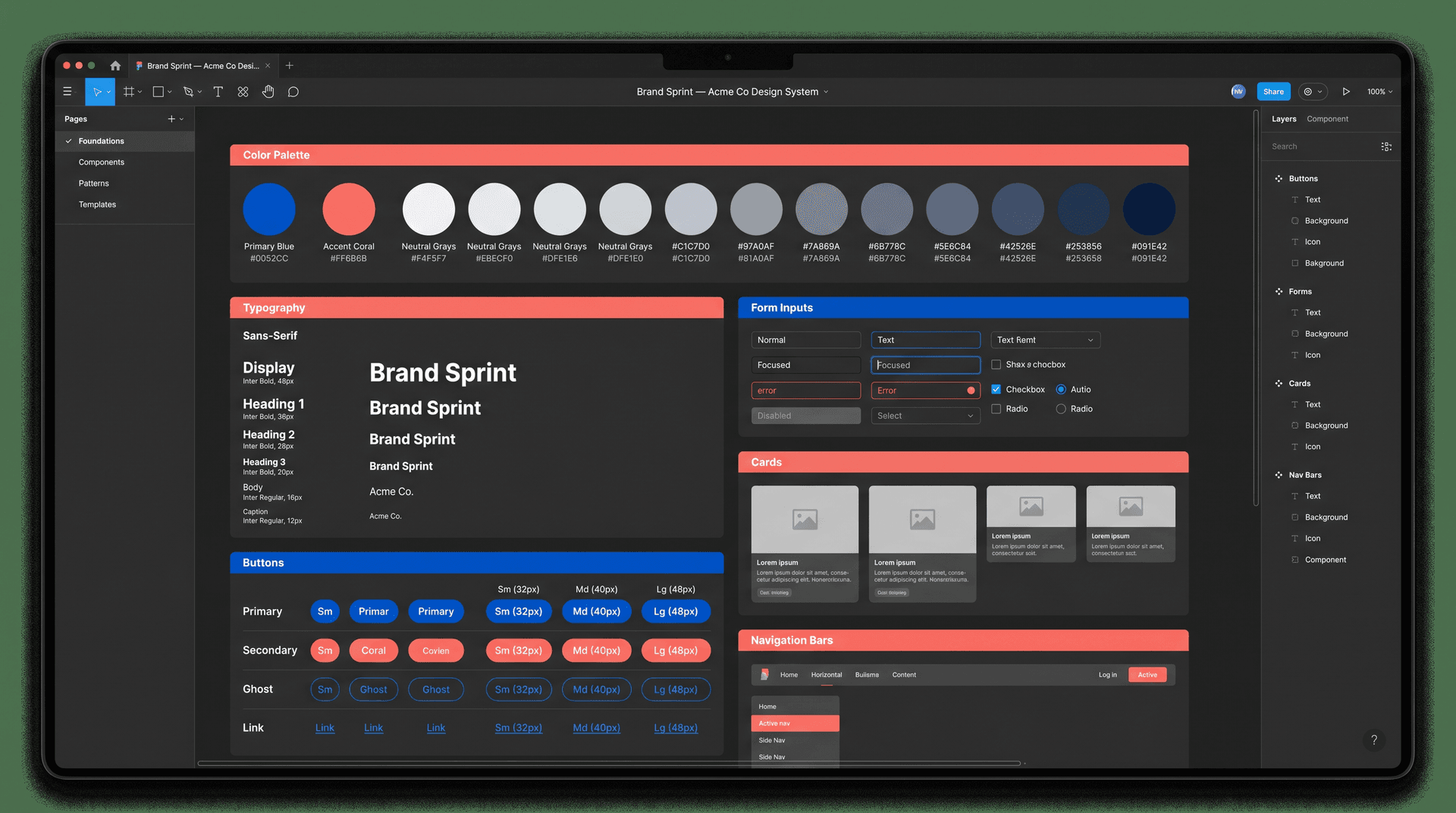
Design system — 84 components, tokens centralized, all states documented in Figma.
What shipped.
The verbatim ship record, given timeline structure.
- log · entry 01
Custom SVG wordmark and monogram, optimized for 24px favicon through 200px hero scale, monochrome-first with an accent color variant.
- log · entry 02
Type system: display + body pairing, full size scale tokenized, line-height and letter-spacing rules documented per breakpoint.
- log · entry 03
Color system: 12 tokens covering surfaces, content, borders, accent, and feedback states. All mapped to Tailwind theme variables and CSS custom properties.
- log · entry 04
Voice document: 4 pages covering tone, sentence rhythm, vocabulary inclusions and exclusions, and 8 before/after copy rewrites from the existing site.
- log · entry 05
Site treatment: navigation, hero block, services grid, footer, and OG image template applied across all critical pages with no broken layouts on mobile.
- log · entry 06
Handoff package: SVG asset library, brand guide PDF, voice document, and a half-day office-hours block to answer follow-up questions during week three.
What it proved.
Identity shipped on day 10. Site relaunched with the new system on day 11. No follow-on rebuild or retroactive cleanup work needed.
Founder reported the new system reduced time-to-publish on new pages and posts because the voice document and color tokens removed the per-page decision overhead. New pages now ship in hours, not days.
Pattern: a Brand Sprint pairs naturally with a Brand Care retainer. The Sprint sets the system; Brand Care keeps it consistent as the business adds new offers, services, and case studies. Together, they remove the slow drift that normally erodes an identity over the first 18 months.
Available on request.
- Brand brief document (template)
- SVG wordmark and monogram set
- Color and type token map (Tailwind + CSS)
- Voice document (template)
- One-page brand guide PDF
Talk to people on this work.
No fabricated quotes. Reference contacts are shared during discovery, with both parties' consent.
Engineering lead
Worked alongside on production trading systems for 5+ years. Available for technical reference calls — code quality, on-call discipline, incident behavior.
Founder
Engaged Sage Ideas for a Ship + Operate combination. Willing to talk about scope discipline, timeline accuracy, and what handoff actually looked like.