AlphaStream — ML Trading Signal Engine
Five models. Two hundred indicators. No black boxes.
A Python-based ML signal engine with 200+ technical indicators and 5 ensemble models — explainable, auditable, and open source.
- Role
- Design + build + operate
- Client
- Sage Ideas (Internal)
- Category
- AI/ML
- Status
- Operational

Indicators
200+
ML Models
5
GitHub Stars
5★
External Forks
2
Buyer read
What changed here?
Use this as proof for analytics, AI, and data-heavy builds where trust depends on visibility.
Before
A signal engine is useless if the user cannot see why a prediction fired or whether the workflow can be trusted.
System
A Python ML engine with 200+ indicators, five models, explainability, backtesting, and public repository proof.
Result
The system turns model output into inspectable reasoning, so technical buyers can evaluate the signal instead of guessing.
200+
Indicators
5
ML Models
5★
GitHub Stars
Living architecture
Surface ⇄ System
AlphaStream is presented as both the product people touch and the operating system underneath it: UI, data model, integration path, evidence, and outcome.
Build an AI workflow- 01Visible productScreenshots and product frames show the user-facing surface without pretending concept art is production proof.
- 02Operating architectureThe case includes a system map so the architecture is visible, not buried in prose.
- 03Evidence registerMetrics, build logs, diagrams, CI artifacts, and links separate actual work from agency theater.
- 04Commercial pathThe page routes qualified buyers toward a matching build, automation, or lab entry.
// scroll to x-ray the build
surface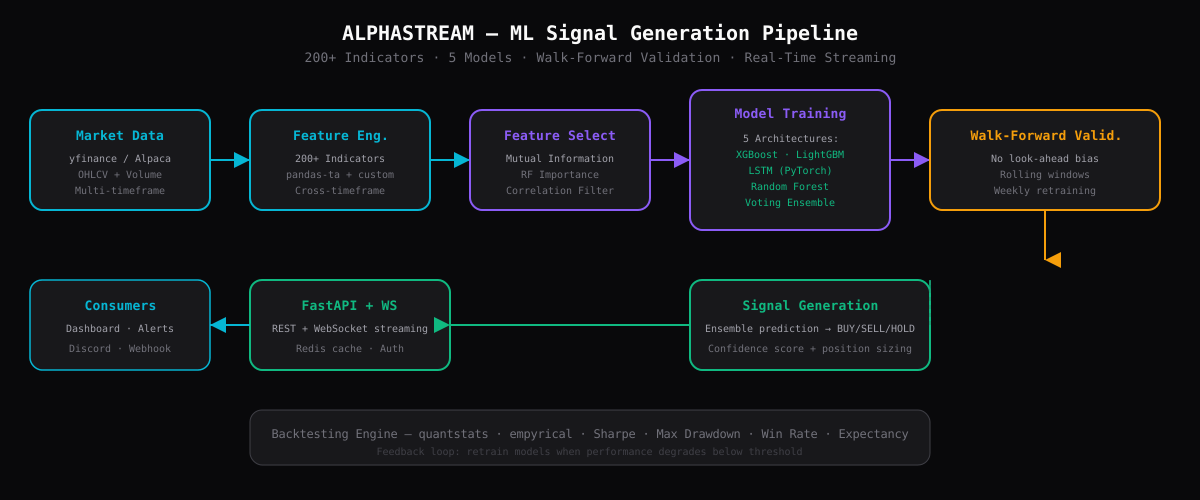 system
case flow
Surface ⇄ System
AlphaStream operating map
The diagram is intentionally simplified: it shows the buying logic and operating path, not a decorative fantasy architecture.
client
Sage Ideas (Internal)
category
AI/ML
evidence
2 assets
Proof board
Receipts before claims.
This page separates shipped surface, system map, real metrics, and available artifacts so the work can be inspected instead of just admired.
proof assets
7
Screens, gallery, artifacts
screens
2
Real product surfaces
artifacts
3
Available during discovery
Primary evidence
200 indicators. 5 models. Open source.
Indicators
200+
Indicators
200+
ML Models
5
GitHub Stars
5★
External Forks
2
Surface
Product screenshots and interface frames show the user-facing layer. If real assets are unavailable, the page says so instead of dressing mockups as production proof.
System
Architecture diagrams, build logs, and artifacts make the hidden operating layer visible to technical buyers.
Signal engine proof loop
Surface, system, proof, route.
This storyboard turns the case study into a moving operating map: the buyer sees what was built, where the system lives, and which proof points are actually available.
- indicators
- 200+
- models
- 5
- forks
- 2
What was broken.
Most algorithmic trading tools are black boxes — a signal output with no visibility into why it fired, what inputs drove it, or how it would have performed historically. For a technically sophisticated trader, that's not a tool. It's a guess with a UI.
AlphaStream was built around a different premise: every signal should be explainable, every model should be auditable, and the entire system should run in Python on hardware you control.
The challenge: building a signal engine simultaneously comprehensive enough to cover 200+ technical indicators across multiple timeframes, fast enough to process live market data without falling behind, and transparent enough that a practitioner can understand exactly what drove each output.
How it was built.
Data layer: market data ingestion from multiple sources, normalized into a unified OHLCV + extended data model. Indicator layer: 200+ technical indicators computed via pandas, TA-Lib, and custom implementations — RSI, MACD, Bollinger Bands, ADX, Ichimoku, custom momentum composites.
ML layer: 5 models trained per instrument/timeframe — XGBoost (gradient boosting, primary signal), LightGBM (secondary signal, speed-optimized), Random Forest (confidence calibration), Ridge Regression (trend baseline), and an Ensemble Voter combining all four with learned weights. Backtesting via walk-forward validation with held-out test sets — no look-ahead bias.
Feature engineering is where the edge lives. The 200+ indicators aren't noise — they're the vocabulary the models learn from. The ensemble architecture ensures no single model dominates, and the agreement score tells you when the models disagree (which is itself a signal).
The system map.
How the pieces talk to each other.
Measured, not asserted.
The real figures from the engagement, printed verbatim. Bars are scaled against the largest comparable magnitude in the set — a secondary cue, never the source of truth.
Selected screens.
Real product surfaces from the engagement — not stock illustrations.
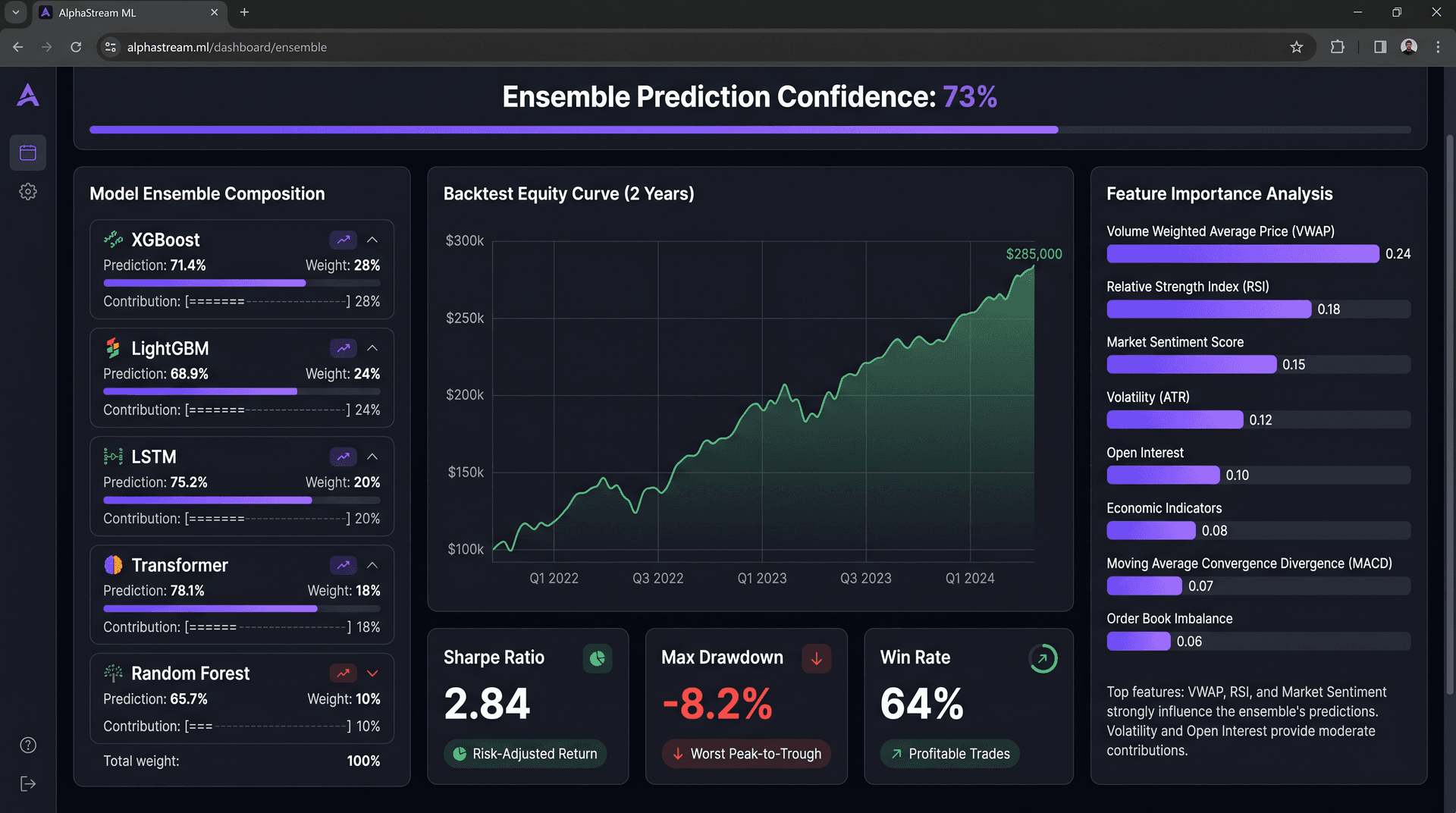
Live dashboard — 14 strategies running, 200+ indicators streaming, latency under 200ms.
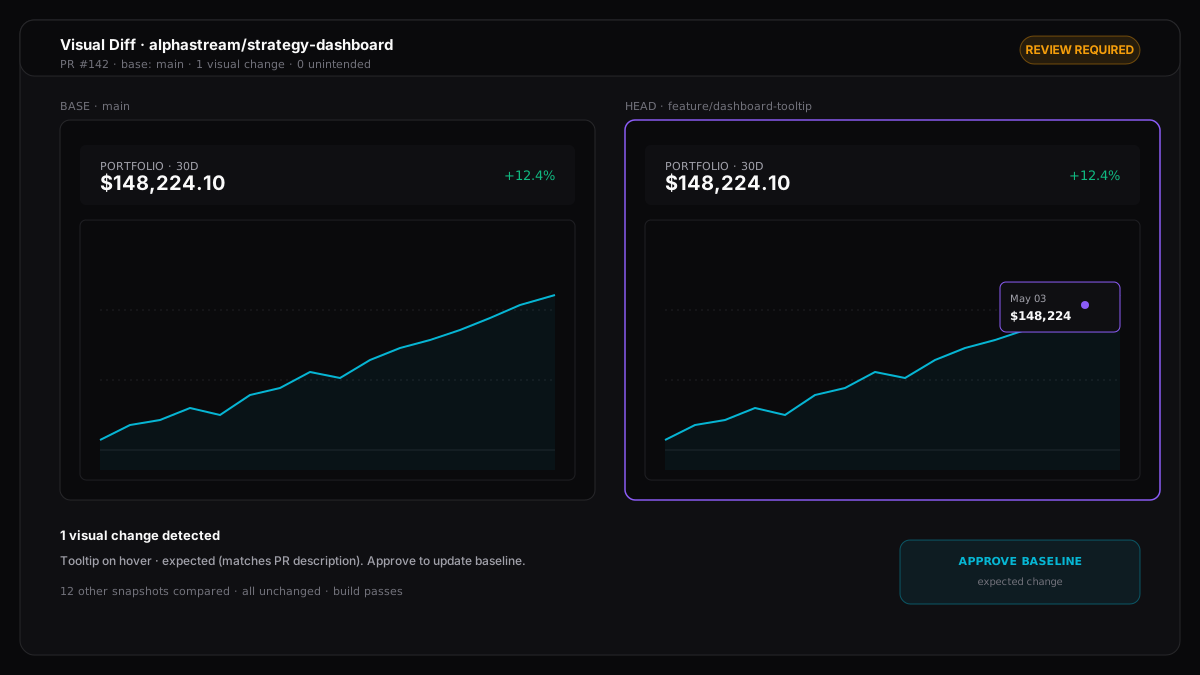
What it actually looks like.
Architecture diagrams, CI runs, and dashboards from the engagement.
What shipped.
The verbatim ship record, given timeline structure.
- log · entry 01
Python package with clean CLI and programmatic API. 200+ indicator implementations (TA-Lib + pandas + custom). 5 trained model pipeline (XGBoost, LightGBM, RF, Ridge, Ensemble). Backtesting engine with walk-forward validation.
- log · entry 02
Signal output with explainability layer (feature importance, SHAP values). Public GitHub repository: 5★, 2 forks, active maintenance. Full documentation including strategy examples.
What it proved.
5★ GitHub rating from practitioners in the quant/algo trading community. 2 forks by external developers extending the system for their own use cases.
Walk-forward backtests across multiple instruments and timeframes demonstrating consistent signal quality. SHAP explainability output allows practitioners to understand per-signal feature attribution.
ML signal engines for trading don't require a hedge fund infrastructure team. A well-engineered Python package with the right architecture can be built, maintained, and extended by a single practitioner — and released as open source without compromising the core thesis.
Available on request.
- GitHub repository → github.com/jteixeira/alphastream
- Strategy documentation
- Backtesting methodology notes
Talk to people on this work.
No fabricated quotes. Reference contacts are shared during discovery, with both parties' consent.
Engineering lead
Worked alongside on production trading systems for 5+ years. Available for technical reference calls — code quality, on-call discipline, incident behavior.
Founder
Engaged Sage Ideas for a Ship + Operate combination. Willing to talk about scope discipline, timeline accuracy, and what handoff actually looked like.